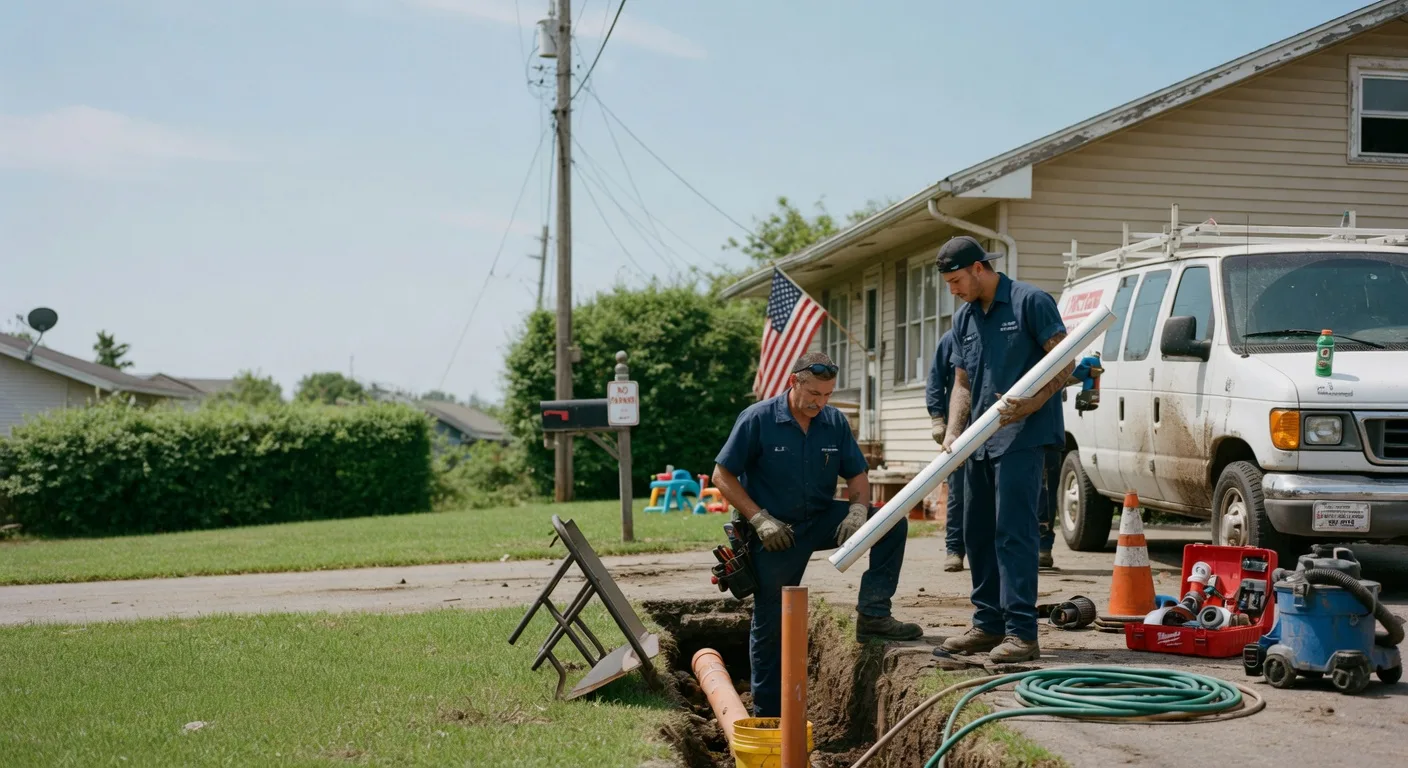
Sewage has backed up into my basement. What do I do right now?
Stop running water in the house now. That means toilets, sinks, showers, the washing machine and the dishwasher. Every gallon you send down the line has nowhere to go but out through the lowest opening, which is your basement floor drain.
Stay out of the water. Keep children and pets away. If you must go in, wear boots and gloves, and do not touch outlets or appliances while standing in it. Do not pour chemical cleaners down any drain.
One safe check: look at whether other drains upstairs are gurgling or slow. If they are, the main sewer lateral is blocked or failing. Typical causes are root intrusion at a clay joint, grease build-up on the pipe wall, a bellied line holding water, or a collapsed section. A single slow fixture is a branch line problem. A basement backing up with the whole house affected is a main line problem, and it needs different equipment.
This is Emergency Drain Cleaning, and it is not a homeowner job. A cable machine at the cleanout can clear a soft blockage. Roots and grease usually need hydro jetting, and a camera inspection shows why the line stopped.
Cost depends on cleanout access, what is found in the pipe, how much has to be removed or repaired, and any permit requirement. Expert Plumbers Co is a referral service. Call (380) 262-9173 and we will refer you to a plumber serving Tate, GA.
Once the water is stopped, take photos of the water line and the affected items before anything is moved, and write down the time you first noticed it. If the backup is sewage, do not use a wet vacuum or a household fan on it, and do not start throwing out porous items until the plumber has opened the line. Tell the plumber what ran just before the backup, such as a load of laundry or a long shower, and whether the floor drain or a basement toilet was the first place it showed. In an older home with a clay or cast iron lateral, the cause is often roots or a collapsed section. In a newer home it is more often a belly, a joint that was set poorly, or a heavy wipe or grease blockage. After the line is cleared, the floor and walls still need proper cleaning and drying, and that is separate from the plumbing repair.
What does it mean if the cable machine stops at the same distance every time?
The cable stops dead at the same spot every time, and the plumber says it feels like a wall. That tells you the problem is fixed in one place. It is not a soft blockage that moves.
Common causes are tree roots that have grown in at a clay pipe joint, a section that has dropped or cracked, or a bellied line where the pipe sags and holds water. It can also be a bad coupling where one pipe no longer lines up with the next. A cable can punch through roots or grease, but it cannot get past a pipe that has shifted or broken.
Note the distance the cable went in. That number tells the next plumber where to look, and whether the fault is inside the house or out in the yard.
Safe homeowner check: if only one fixture is slow, go easy on water and note which drain it is. Stop running water and call now if several drains back up, if water comes up in a tub or floor drain, or if there is a sewage smell indoors.
A camera inspection is the right next step, because it shows what the cable hit. Roots or heavy grease may clear with hydro jetting. A broken or bellied pipe is a repair, and the cost depends on access, how much has to be dug or opened, the materials, and any permit required. Expert Plumbers Co is a referral service. Call (380) 262-9173 and we will connect you with a plumber in Tate, GA for Drain Cleaning.
Mark the spot where the stoppage sits if the cleanout or access point makes that possible, and tell the plumber whether the line runs under a slab, a driveway or a lawn. That decides how the repair is approached and how much has to be opened up. In older homes, the stoppage is often a clay joint that has been invaded by roots or has slipped, and the fix may be a spot repair on one section instead of replacing the whole run. In newer homes a stop at the same distance is more often a poorly set joint or a fitting that was installed out of line. After the camera has found the fault, ask for the footage or a few stills. They show the pipe material, the condition on either side of the problem and whether other weak points are coming. Until the repair is done, expect the line to clog again, so keep water use low and avoid putting anything but waste and paper into it.
We just built or remodeled and the drains are already slow. Why?
The plumbing is new, and the tub drains like an old one. Or the sink gurgles whenever the washer runs. New work should not do this, and the cause is usually in how the pipe was set.
Four causes come up. First, not enough fall on a horizontal run. Water needs slope to carry solids, and a flat run leaves them behind. Second, a vent that was never tied in or was capped. The line cannot breathe, so you get gurgling and slow flow with no clog. Third, construction debris left in the line: grout, drywall mud, thinset, sand. It sets hard on the pipe wall. Fourth, a trap arm run too long.
One slow fixture points to its own trap arm, slope or vent. Several fixtures slow together, or the lowest drain backing up, points to the main run, a debris plug or a vent problem.
Safe homeowner check: note which fixtures are slow and listen for gurgling. Do not climb onto the roof. Stop running water and call now if water or sewage comes up in a tub or floor drain.
A camera inspection is the right first step on new work. It shows a flat section, a ridge of hardened material on the pipe wall, or a vent that never connected. Repeat cabling just pokes a hole through the problem, and it returns. A cable machine is enough for a soft, loose blockage. Hardened cementitious debris often needs hydro jetting. Slope and vent faults need the piping corrected, and what that involves follows access, materials, how much has to be opened up, and any permit or inspection.
Expert Plumbers Co is a referral service. We refer homeowners in Tate, GA to an independent local plumber for Drain Cleaning and Emergency Drain Cleaning. Call (380) 262-9173.
Keep a record while the work is fresh. Photograph any open walls or trenches before they are closed, and write down the date the slow drains first showed up. If a builder or remodeling contractor did the work, the fault may be theirs to answer for. A written note from the plumber describing what the camera found, such as a flat section or hardened debris, helps far more than a general complaint.
Tell the plumber when the work finished, which fixtures were added and whether the main line was touched.
A common mistake is pouring strong drain chemicals into a new line. They rarely touch hardened grout or thinset, they can damage fittings, and they make later cabling or jetting unsafe for whoever handles it. Another is waiting for the problem to settle. Construction debris does not wash away. Ask whether any air admittance valves were used in place of a full vent, and whether local code allows them.
Can a drain cable or hydro jetting damage old pipes like cast iron, clay or thin-wall pipe?
Yes, it can, and a good plumber knows that before the machine is switched on. Old pipe is not equally fragile everywhere, and the choice of tool depends on what the pipe is made of and what shape it is in.
Cable machines spin a cutting head against the pipe wall. In sound pipe that is fine. In clay with offset joints, the head can catch on a lip and snag. In cast iron with heavy scale, a cutting head can knock loose flakes, and in a pipe already thinned by corrosion it can punch through. Thin-wall plastic or older Orangeburg-type fiber pipe can be gouged or deformed.
Hydro jetting pushes water at high pressure through a nozzle. On solid pipe it cleans the walls better than a cable. On a cracked clay pipe, a corroded cast iron stack, or a joint that has already shifted, that pressure can widen the damage or send water out into the soil.
So how does the plumber decide? Usually from several clues:
The age and material of the house and the pipe, which tells the plumber what to expect.
Past history, such as repeated roots, earlier repairs, or a line that has never been inspected.
How the cable behaves. A head that bounces, stops at the same distance, or comes back with pipe chips or rust flakes suggests the pipe itself is damaged.
A camera look first. This is the most direct answer. If the line is fragile or offset, the plumber can choose a gentler head, lower pressure, or no jetting at all.
If you suspect old pipe, say so on the phone. Tell the plumber the age of the house and the pipe material if you know it. Ask whether the tool will be matched to the pipe, and whether a camera look comes first.
Sometimes the honest answer is that a quick clearing is worth the risk to get water moving, with a plan to inspect afterward. Sometimes it is not. Either way, the decision should be explained to you before the work starts, not after.
If you need a drain cleared in Tate, GA, Expert Plumbers Co can connect you with an independent local plumber at (380) 262-9173.
Since we put in a water softener, the floor drain or laundry drain backs up when it regenerates. Are they related?
The softener finishes its cycle and a minute later the laundry drain gurgles or the floor drain spits up gray water. You did not have this before, so it is fair to wonder if the softener caused it. In most cases it did not cause the clog. It exposed one.
During regeneration, a softener flushes brine and rinse water out through a drain hose, usually into a standpipe, laundry tub or floor drain. That water arrives in bursts, and the volume is sudden. If the drain line is clear, it carries the surge without trouble. If the line has a partial clog, such as grease build-up on the pipe wall, a root mat at a clay joint or a belly holding water, the burst is more than it can pass, and the water rises in the lowest drain.
The discharge also needs to be set up properly. Most plumbing codes require an air gap, a physical space between the end of the softener drain hose and the drain, so wastewater cannot siphon back into the softener. A hose pushed deep into a standpipe, or taped tight to it, can cause splashing and backflow of its own. Rules vary by area, so the installer or local building department can say what applies in Tate, GA.
The key question is how widespread it is. If only the standpipe backs up, the trouble may be the standpipe, its trap or the softener hose. If the floor drain, laundry drain and a basement toilet all react, the main drain is partly blocked, and the softener is just the first thing to push it over the edge.
Safe homeowner check: look at where the softener hose ends. Make sure it sits above the drain with a visible gap and is not kinked or pushed down inside the pipe.
Stop running water and call now if sewage is coming up through the floor drain, if water is spreading across the floor, or if you smell sewage.
A cable machine is often enough for a soft clog in a short branch. If roots, a belly or grease are suspected, the work calls for a camera inspection and hydro jetting.
Expert Plumbers Co is a referral service. We connect you with an independent local plumber in Tate, GA. Call (380) 262-9173.
Tell the plumber the problem started after the softener went in and when in the cycle it shows up. Ask them to check the air gap and the standpipe as well as the main. Scope depends on access to the line, parts for any standpipe or hose changes, how much has to be opened up if a section is damaged, and any code requirement.